Quentin Tarantino’s double movie Kill Bill Volumes 1 and 2 tells the story of a female assassin’s quest for revenge against those who betrayed her. Beatrix Kiddo AKA The Bride was gunned down at her wedding rehearsal by the Dead Viper Assassination Squad, of which she was once a part of. Her former love and master, Bill, shot the pregnant bride in the head, putting her in a coma for four years. Upon awaking from her coma, she set out on a mission to kill each member of the squad, most importantly of all, Bill. On the surface, the text appears feminist, featuring a powerful female in an unexpected, physically demanding role. On looking further, the extreme violence and theme of pregnancy and sacrifice seem to contradict feminism. However, this paper will attempt to sort through the contradictions. I will argue that the character of Beatrix Kiddo embodies a feminist interpretation of femininity in her complexity and fluidity. She displays an ability to perform both feminine and masculine roles in her behavior, dress, and interactions with other characters, resulting in an evolving, complicated identity and a characterization that is ultimately feminist.
In attempting to define femininity and masculinity, I realized I was making the mistake of giving validity to words which are based on abstract stereotypes rather than reality. Gender stereotypes are traditionally defined as a presence or absence of specific personality traits (Deaux, 290). In a report that based on an extensive investigation in 30 different nations William and Best (1982) found, “men are typically viewed as stronger, more active, and higher in achievement autonomy and aggression. Women are weaker, less active, and more concerned with affiliation, nurturance, and deference” (Deaux, 291). The problem with these stereotypes is that fail to account for fluidity and variation in behavior given a situation, as well as the many exceptions in which a man or woman doesn’t fit the stereotype. Deaux points out that the two features that may be most influential in determining male or female gender are the male’s larger size and greater strength and the female’s ability to give birth. Aside from these two signifiers, the other traits are not based on concrete evidence. She is careful to point out that there is “overlap in virtually all behaviors” associated with masculinity and femininity, and that the concepts are “multidimensional” and “inherently flexible…not explanations but simply labels” (300, 301). In her article Masculine Femininities/Feminine Masculinities: power, identiy, and gender, Carrie Paechter agrees,
“Kessler and McKenna’s (1978) classic study suggests that ‘male’ and ‘female’ are examples of what is referred to in philosophy as a ‘cluster concept’: one that is not amenable to straightforward definition but is recognized through a cluster of attributes, some of which are more salient than others, but which may not all be present. The gender binary, in consequence, only operates at the level of the label” (258).
I think it is important to be skeptical of the terms “male” and “female.” I understand the necessity of having language to discuss disparities between biological sexes, but ascribing a set of characteristics to the terms is an act of stereotyping.
Furthermore, positioning the terms masculine and feminine as opposites creates a one-dimensional concept that inhibits the understanding of gender identity. As Deaux points out, “Most often, the general concepts of masculinity and femininity are viewed in terms of opposition, with the presence of one set of characteristics implying the absence of the other” (292). The terms then become part of the gender binary, establishing two rigid categories under which one must fall, failing to account for the disparities, the gray areas, and the overlap that occurs in an individual’s identity. How we behave as masculine and feminine varies with time, place, and circumstance (Paechter, 259). Furthermore, femininity and masculinity are not as much inherent qualities in an individual as a position one occupies in relation to a situation (Haskell, 89). Simone de Beauvoir writes:
“In actuality the relation of the two sexes is not quite like that of two electrical poles, for man represents both the positive and the neutral, as indicated by that common use of man to designate human beings in general; whereas woman represents only the negative, defined by limited criteria, without reciprocity” (1).
If women are defined in relation to man, the conclusion would be that to be feminine is to be lacking masculine qualities; the terms themselves then become an act of subordination. Gender is penetrable, evolving, and inconsistent. While language is important for discussion purposes, it constrains our concept of gender because it compulsively labels and categorizes. Therefore, a feminist definition of gender wouldn’t be a definition at all- it would allow the individual to determine their own gender identity.
The Kill Bill movies present a unique example of the fluidity of gender identity in the heroine, Beatrix Kiddo. Throughout the film, she occupies the roles of deadly assassin and mother. Her physical strength and aggressiveness are stereotypically masculine, while her role as a mother is inherently feminine. Both roles she assumes are emphasized as natural. Bill, in the final scene of the movie, calls her a “natural born killer,” which is interesting because men are the ones typically seen as “natural” predators. On the other hand, despite being a killer, Beatrix is gentle and affectionate with her daughter when they are reunited in the final scene. Classifying Beatrix Kiddo as either masculine or feminine is impossible; she defies the gender binary. In this way Quentin Tarantino, the writer and director of the film, and Uma Thurman, the actress who portrays her, develop a characterization of Beatrix Kiddo that is feminist in its gender ambiguity.
Beatrix Kiddo’s appearance changes and evolves constantly throughout the movie. In the opening scene of both Kill Bill Volumes 1 and 2, she is bloody, dirty, and sweaty, showing obvious pain. While Uma Thurman is physically attractive, she is also unafraid to be “ugly.” In the scene where she awakes from her coma to realize that she has lost the baby she was pregnant with, she shows the kind of emotional turmoil that is unpleasant to view. It is a humanizing moment, one which the character becomes less of a cartoon and more of a complex individual. Also, in the second installment, we see Beatrix Kiddo as a beautiful and obviously pregnant bride prior to the wedding massacre. Here she is the ultimate stereotype of femininity; she is wearing a soft, white dress and is glowingly pregnant. Later, she dons a yellow, androgynous jumpsuit she when she initiates her own massacre of one of her nemesis O-Ren’s entire entourage. The final scene is interesting to me because she finally arrives at her destination where she is to kill Bill once and for all, and she is wearing a long, flowing skirt. It seems at the end of the journey she has come into her identity and isn’t donning a costume to assume the role of Beatrix the masculine female to be an intimidating warrior.
There are some actions Beatrix takes that are not in sync with feminist thought and could be interpreted as stereotypical. The largest, in my opinion, is the fact that the very day she found out her pregnancy, she abandoned her life as a hired assassin and moved to a small town to marry, work in a used record store with her husband, and raise her child. This was a decision, when confronted by Bill in the final scene, she admits she did not think would work. In what her critique of women’s films of the 1930s and 40s, Molly Haskell describes the theme of sacrifice, in which a woman must sacrifice herself for her children, and the film “may end happily, with the wife/mother reclaiming her husband/child when her rival dies” (Haskell, 24). She elaborates on her criticism, calling a woman “consumed by her maternal zeal” a mainstay of “American culture and middle class marriage,” resulting in a “conviction that children are the reason for getting married” (Haskell, 27). For a film that was made about 60 years after the films Haskell describes, the subject matter is strikingly similar. Beatrix gives up her independent identity after, as she says, “the strip turned blue” on her pregnancy test. The decision is disappointingly cliché, but it is only the beginning of the Bride’s story and therefore part of her evolution. Her adherence to the stereotypical female role in this situation and the rejecting of it further in the movie is additional evidence of the flexibility of her gender identity.
In addition, via flashbacks, we see that Beatrix wasn’t always an independent agent. Bill was not only her lover, but also her “master.” He had her trained by Pai Mei, the most overtly misogynist character in the entire film. She is put through intense physical torture under his tutelage, but ultimately she becomes stronger. As a result of his training, she was not only able to escape being buried alive, but was also finally able to defeat Bill in the final scene, using a kung fu maneuver Pai Mei taught her. Beatrix evolved from a subordinate identity to an independent identity, which contrasts the vast majority of films featuring females that go from single to married.
Furthermore, through her aggression, physical prowess, and ability to forgo emotion for the sake of rationality she embodies characteristics generally thought of as masculine. For example, in the scene in which she fights Vernita Green in her suburban home Beatrix explicitly says, “Its mercy, compassion, and forgiveness I lack. Not rationality.” Rationality, thought to be a male trait, is the one trait she owns up to, dismissing the typically feminine virtues of compassion and mercy. By distancing herself from stereotypical femininity she is claiming power and concurrently rejecting the disempowerment that comes from positioning oneself as female (Paechter, 257). She not only verbally rejects femininity, she goes on to murder countless men and women while maintaining level-headedness, agility, and composure. In Simone de Beauvoir’s introduction Woman as Other she writes that women “have gained only what men have been willing to grant; they have taken nothing, they have only received.” In her life before she awoke from her coma, Beatrix lives up to de Beauvoir’s assertion. She received training only when Pai Mei acquiesced, she lost her life while in a coma for four years where she was repeatedly raped, and her child was literally taken out of her stomach. After awaking from her coma, she murders her abusers and takes their vehicle, she gets her revenge by literally taking the lives of her enemies, and she eventually takes back her daughter from Bill. In her journey throughout the two films, Beatrix acquires everything important and valuable to her by taking- not receiving- from men.
The parts where the fluidity of her gender identity is most evident are in the ways she moves between masculine and feminine roles within the same interactions.For example, upon first encountering Hatori Honso, the man she wished to make her a priceless samurai sword, she first pretends to be naïve to Japanese language, which she speaks fluently, and she giggles timidly, obviously attempting to charm him. When he has warmed to her, she abandons the act and proceeds to speak to him in Japanese and holds steady eye contact, assertively telling him she wants him to make her a sword for nothing in return. The example illustrates the performance aspect of gender roles, and the ease with which she executes performing them to get what she wants shows that her identity is complicated. She executes a similar strategy with Esteban Vallejo, a father figure of Bill’s and a pimp, by complimenting him and laughing coyly at his jokes, playing a feminine role until him until she feels confident to get what she wants out of him- Bill’s location. She manages to get both the sword and Bill’s location through performing gender roles.
I think it is also worth noting that Quentin Tarantino was raised by a strong, independent woman without his father present (Rich, 1). That would likely color the way he views strong women in a favorable way. In an interview, Tarantino has also said “This movie does not take place in the universe that we live in. In this world women are not the weaker sex. They have exactly the same predatory hunting instincts as the men, the same drive to kill or be killed.” This could be taken as anti-feminist in that he is inferring that in the “real world” women are the weaker sex. On the other hand, he could be implying that there is a perception that women are the weaker sex, which is true. While many feminists cry misogyny when they see the treatment of Beatrix Kiddo in Kill Bill, I would find it strange if there was no violence against her. She is, after all, a deadly assassin on a revenge mission, and she is involved in multiple battles with both men and women. In addition, from Reservoir Dogs to Pulp Fiction, Tarantino’s films are known for their excessive violence, and Kill Bill is no exception. Unrealistic as the film may be, presenting a strong, powerful, multi-faceted female lead in a scenario in which she triumphs without the help of any man is, in my opinion, a feminist characterization, whether or not Tarantino identifies as a feminist.
If masculinity and femininity in a feminist perspective are intertwined, flexible, and variable, then the characterization of Beatrix Kiddo’s gender identity is feminist. She doesn’t conform to a specific way of dressing, though she is most recognizable in her androgynous jumpsuit. Her behavior ranges from stereotypically feminine as a blushing bride, to a caricature of masculinity as a sword-wielding assassin. In interactions she displays competency in acting out each role- female when she wants to charm men and male when she wants to intimidate aggressors. Her gender identity operates independent of her biology and sexual orientation. It is ambiguous and defies labels and binaries, thus making the media text of Kill Bill, with regards to Beatrix Kiddo, essentially feminist.
Friday, April 25, 2008

Audris Insixiengmay: Media Analysis
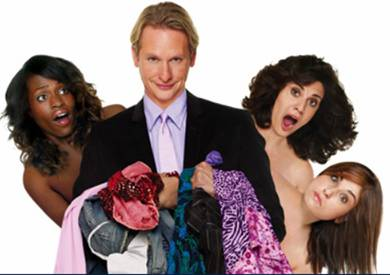
Media Analysis: How to Look Good Naked: A Queer Eye's View of the Beauty Myth
Commercials, runways, billboards, magazines, movies, sitcoms – it seems that today's women are being ambushed from every angle by the “Beauty Myth”, the belief that there is a singular, exclusive, pristine image of perfection and that this image is what self-respecting women everywhere should look like (Wolf 120). Fortunately for the vast majority of us that are not a size 0 there is How to Look Good Naked and shows like it that herald an enlightening message: despite what size bra you wear, the color of your hair, or how many kids you have had, you are beautiful. However, it is hard to view the show without a feminist lens and an uncritical eye. Although the message HTLGN sends is an overall positive one, it still feeds the multi-billion dollar cosmetics industry that pays for those models in the magazine ads and those billboards beside the freeway. Though it cannot be denied: the media has grown to become more accepting of women of varying shapes, colors, and sizes, the fact is that women are still primping for hours before a mirror prior to setting foot outside their front doors which only breathes fresh, sustaining life into the Beauty Myth.
When Naomi Wolf wrote her article in 1991, I am pretty sure she did not for see the myriad makeover shows sprinkled throughout cable television networks, including How to Look Good Naked, a show that premiered earlier this year on Lifetime. Hosted by Queer Eye for the Straight Guy's Carson Kressley, the show helps body-conscious women get rid of the painful, damaging images they have of themselves in exchange for an more approving, self-loving view. In January, Kressley appeared on Good Morning America to give audiences a preview of HTLGN. Kressley told Good Morning America: “The point of the show is to say you don't have to be perfect to be beautiful”, you can be beautiful just as you are (ABC). In a world where nothing less than perfect is acceptable, the show's message appears to be a positive one. Nicole Cohen of Herizons magazine observes that “beauty standards have evolved from functioning as visual health cues to becoming bodily insecurities companies [use] to hawk lipstick and liposuction” (37). I can walk into any drug store or supermarket and see entire aisles devoted specifically to women's cosmetics and care: face creams and body lotions, hair straighteners and curling serums. With so much evidence to woman's undeniable imperfection, how can we ignore the need for improvement? Kressley acknowledges that women today cannot help but be sucked into an oppressive, self-deprecating state of mind because of the myriad size 0's dancing in music videos or clear-skinned, long-lashed bombshells serving chicken wings in the local bars. He proceeds in the interview – and on the show itself – to share tricks of the trade that help.
Nevertheless, is that enough? Makeover shows may take the outward appearance of media-oppressed women and morph it into the “goddess within”, but is that enough to cancel out the decades of promoting botox, bronzers, and boob jobs? Sheila Mason articulates that “over the past thirty years...women have gained increasing access to work and leisure opportunities that were previously inaccessible to them. Social and philosophical obstacles to collective self understanding have diminished with the appearance of emancipatory social movements” such as feminism and lesbian, gay, bisexual, and transgender awareness (Beyond flow 233). Women have overcome paramount obstacles over the past years in order to gain an equality that was once unheard of. Yet in spite of all our accomplishments, we are still struggling under the yoke of the Beauty Myth. A point that Wolf makes in her essay is that “'beauty' is not universal...nor is beauty a function of evolution”, in essence beauty is fluid (Beauty Myth 121). A beautiful woman to a man in Kenya will undoubtedly be different from a beautiful woman to a man in Japan, but because the media has tattooed an exclusive image into our minds, women cannot help but feel inadequate with what they have. In this way HTLGN can be applauded because the show helps society's women who are so often disappointed with their reflection – in some cases, to the point of tears – realize that they do not need to fit the prototype to be beautiful. You can be four foot seven and still look sophisticated, you can wear a size 14 jean and still exude confidence.
However, does self-appreciation reciprocate the fact that HTLGN is still working for a system that capitalizes on women's need to buy beauty products and trendy outfits? Not necessarily, but I do feel that women – and men – should feel good about looking their best. In addition, looking your best does not mean plastic surgery and starvation. Everyone – man, woman, transgender – has the potential and the right to look as good as the next person. I personally adore makeover shows because they make me realize that there are women in the world who are so insecure about the way they look on the outside that it effects how they feel about themselves on the inside. And it is because of the Beauty Myth that 99% of women are unhappy with their bodies. However, shows like HTLGN show women that there is nothing to be ashamed of, there is nothing that they should envy; every woman is beautiful and it starts with how they feel about themselves. It was for this reason that I chose to do my media analysis on HTLGN.
So, it is true that How to Look Good Naked raises the consciousness of women about body images and shows them that the “ideal” body image is nothing but a myth. Nevertheless it is also true that shows like HTLGN continue to oppress women with the fact that beauty is only as good as the clothes you wear and the highlights in your hair. The Beauty Myth cannot be vanquished with shows like HTLGN; they only prolong the fight to liberate women from the yoke of commericalism, the need to wear mascara and lipstick.
Check out full episodes here
~Remember! Regardless of who you are or what you look like, flaunt it!!!
Greene: Media Analysis
Applying Feminist Thought to “Secret Life of a Soccer Mom”
Representations of women and men in the popular media often reflect society’s assumptions about gender roles; portrayals of “real” women and men in reality based television shows are no exception. Reality television, just one of many media outlets that “claim to present reality” (Nabi et al 304), can be defined as programming that “film[s] real people as they live out events (contrived or otherwise) in their lives, as these events occur” (304). While reality based programming endeavors to represent unscripted events and dialogue, individuals on these shows can typically be seen acting out their gender scripts, implicit regulations woven into our everyday lives that consciously and unconsciously guide men and women’s behavior. One reality show, however, has attempted to reverse the typical gender roles by offering stay at home mothers the opportunity to work outside the home.
On TLC’s “Secret Life of a Soccer Mom,” women who nominate themselves for the show are given one week to secretly participate in their dream careers while their families believe they are vacationing at a spa. When the week is up, the women reveal their “secret lives” to their families and choose whether or not to keep their jobs. On the first episode of the series, stay at home mom Adrian is given the chance to work as a high-end fashion designer for one week, eventually deciding that she will keep this career permanently. In my analysis of this episode, I will argue that although this show offers some women a unique opportunity to cast aside their expected roles of wife and mother, it is not a fully feminist text because it ignores the systemic barriers that working mothers must face and presents working outside and inside the home as mutually exclusive roles. Further, I will examine this episode using a second wave feminist framework to illustrate the ways in which current obstacles facing mothers intersect with past feminist struggles.
In the first episode of TLC’s “Secret Life of a Soccer Mom,” viewers are introduced to Adrian, a stay at home mother of three who studied fashion design in college. After nominating herself for the show, Adrian was chosen as the first contestant to secretly experience her dream career for one week. During the episode, Adrian tells her family that she will be relaxing at a spa for the week as a reward for all of her hard work at home. Her husband, a physician, must care for their children and the house. Both experience hardship; Adrian’s design skills are called into question by her coworkers and her husband’s lack of experience in the home is apparent. Although Adrian leaves a list of instructions, he questions their validity, saying he “can’t be bothered” to follow them. Meanwhile, his toddler daughter is seen drinking and spilling a bottle of coffee creamer, which she insists on cleaning up herself without any objection from her father. At work, Adrian’s fabric choices and design concepts are criticized, and when she completes a small collection of clothes to be anonymously evaluated alongside another designer’s, only one of her outfits is praised. The episode culminates in an emotional scene where Adrian tells her family about her new “secret life” and informs them that the design firm she worked for would like to hire her full time. After a short discussion with her family, Adrian decides that she will continue to work as a fashion designer outside of the home.
Although this episode reveals definite feminist themes and empowers one woman by offering her the opportunity to enter the “public sphere,” the overall nature of the show posits it as a less-than-feminist text. Women on the show view it as an opportunity to “fulfill a dream” (The Secret Life of a Soccer Mom: Adrian) and expand their identities to encompass more than being a mother, a role often expected of woman and encouraged through socialization from a young age. Adrian says she is satisfied being a mother and that being a stay at home mom is “a balancing act…like in the workforce” (The Secret Life of a Soccer Mom: Adrian), but she is also passionate about fashion design and values this facet of her personality as well. Clearly, the show is a positive experience for the women who choose to participate; whether they decide to return to work or stay at home full time, they are given the chance to examine themselves and their lives and as host Tracey Gold observes, “discover a newfound confidence” (Tracey Q&A) that they may not have had before. However, while the show offers some women the unique opportunity to redefine themselves as working mothers, it offers little commentary on the real tensions that women who work and have children must face.
In reality, motherhood is said to be “the single biggest risk factor for poverty in old age” (Crittenden 193); while class issues certainly influence this statistic, all mothers who work within the home are vulnerable since “government social policies don’t even define unpaid care of family dependents as work” (193). Although Adrian’s family is clearly in a privileged class position on the show, her status as a stay at home mom puts her at severe risk for poverty later in life. Rather than addressing this issue, though, the show glosses over it and sends her into the workforce with no commentary on the struggles that all stay at home mothers must face. While she will be earning an income by returning to work full time, thus potentially “equalizing the balance of power within [her] marriage” (Okin 611), Adrian’s situation is in stark opposition to that of other women who return to work after becoming mothers. Her abilities are questioned for only brief period of time; in reality, mothers who enter the workforce after a long hiatus are often met with resistance since the work they do at home is hardly considered valuable experience in the “public sphere.” Here, the show might have recognized this challenge and somehow integrated it into the first episode; however, little is said about the difficulties real mothers must face when returning to the workforce.
Similarly, the show offers virtually no commentary on the “second shift” job that many women must work when they return home from the job. Although viewers see Adrian’s husband taking care of the children and the home while she is secretly working, his reaction to the work is disheartening. After ignoring his wife’s instructions, he struggles with the tasks that all stay at home mother’s must endure on a daily basis. He cannot keep up with the children, is seen telling his youngest daughter to “stay” like a dog, and allows one child to eat a tube of diaper rash cream. The house is a mess, yet the show portrays his inability to work in the home as humorous, dubbing playful, lighthearted music over the scene.
By representing her husband in this manner, the show reinforces the stereotype that work at home is “women’s work” and perpetuates the idea that it is okay for men to avoid housework and childcare. Pat Mainardi describes this phenomenon in her article “The Politics of Housework;” highlighting the excuses many men use to trivialize work women have traditionally done in the home, Mainardi notes that men often say they do not “do it very well” (189) and that women must “show [them] how to do it” as a way to keep women from asking them to do their fair share. Rather than addressing her husband’s alleged inability to do housework, the show simply portrays him as a well meaning father trying his best. Although he offers to “help out more” when Adrian announces that she will be returning to work full time, this is rarely the reality for working mothers. In the essay “Vulnerability by Marriage,” Susan Okin points out that “many husbands who profess belief in sharing household tasks equally actually do far less than their wives” and that “in many cases, egalitarian attitudes make little or no difference in who actually does the work” (609). In an interview taped during the show, Adrian even notes that she is “in awe” of mothers who work full time and go home to take care of the children; even she does not question the assumption that she will continue to care for the home and the children while working. The show does not address these issues, however, and posits Adrian’s return to the workforce as nothing more than a positive, empowering experience.
While returning to work is undoubtedly “one of the ways that women show their rejection of their role in society” (James 192), TLC’s “Secret Life of a Soccer Mom” offers little relevant commentary on women’s positions as wives and mothers in today’s world. Extending the dialogue that Betty Friedan started during the second wave of feminist thought with The Feminine Mystique, texts on women and work must do more than represent working inside and outside the home as mutually exclusive roles; in reality, these positions are inextricably linked, and a fully feminist text must recognize both empowering and disempowering aspects of working in the “public sphere.” Women must be given the opportunity to move beyond their prescribed roles of wife and mother, but blindly sending women into the workforce without addressing the barriers all working mothers must face is not the answer. The second wave struggle to earn women the right to be working mothers continues, and only by recognizing the work that women do as mothers and employees, offering support for women who wish to work inside or outside the home, and eliminating the economic and social vulnerabilities that working mothers and wives face can we realize this goal. Although the first episode of TLC’s “Secret Life of a Soccer Mom” is not a fully feminist text, perhaps it is a start; at any rate, it illustrates that the issues second wave feminists faced are still applicable and facilitates an open dialogue that may move us closer to equality for all women.
Keep Ya Head Up
Russel Simmons, considered to be one of the pioneers of hip-hop music (Run DMC), says, “There is no question that sexism in hip-hop videos is a reflection of how sexist men are in the world today” (Byrd). This is because of a common theme found in most hip-hop lyrics and videos. Women are constantly referred to as bitches, hoes, tricks, and many other degrading names. In videos, women are typically shown dancing around half naked and sometimes even worse. The problem this causes in society is the message it delivers to listeners and viewers. The message delivered is that it is not wrong to treat all women this way. This message is being implanted in more and more men of all ages each day. In a song called “Keep Ya Head Up,” Tupac Shakur raps about the mistreatment women face each day and calls for men to change their actions with women. A website for the National Organization for Women describes this song as “some of the most black women-friendly lyrics I have ever heard in a rap song.“ This paper will focus on the negative influence our society gets from sexist lyrics and why the lyrics from Tupac’s song, “Keep Ya Head Up,” is a vital message needed for a change to be made in society.
In an article written by Ayana Byrd and Akiba Solomon, they talk about how black women are represented negatively in the hip-hop culture. “In videos we are bikini-clad sisters gyrating around fully clothed grinding brothers like Vegas strippers on meth” (Byrd). This obviously is not how women want to be represented. Feminist from the first and second wave movement would go crazy if they were around to see this behavior. “The damage of this
imbalanced portrayal of Black women is impossible to measure. An entire generation of Black girls are being raised on these narrow images. And as the messages and images are broadcast globally, they have become the lens through which the world now sees us. This cannot continue.” (Byrd). As I continued to read the article, I could really feel the anger and hurt these women have encountered in their own lives. Also in the article, they interviewed a senior from Spelman College who reflects about the negative impact she has heard. “I know people who've been on exchange programs to another country, say South Africa or Brazil, and they've had experiences in which people have approached them, thinking that they were prostitutes or that they were sexually open just because of the images that they have of American Black women” (Byrd). Reading this story proves that a lot of people who hear hip-hop music feel that this is how women want to be treated. Eric K. Watts explains “in song after song, black women are assumed to be ‘skeezers’ or ‘hoodratz.’ And so, a street-oriented young man may view a woman as a pawn to be played in the larger chess game for respect” (498). Watts believes that most songs encourage female abuse (498).
From only these two examples, it is clear to see that there is a problem with how women are treated in our society and that blame should be put on the rappers who write about it and show us said mistreatments in their videos. The reason why so many women, black women especially, are looked down on is that someone who is making millions of dollars makes it seem as if they are only successful because they treated women that way.
Now, before I get into why Tupac’s song delivers a positive message and the importance behind it, I would like to give a little history of his life. The following information is from a biography written by Jamal Joseph titled Tupac Shakur Legacy. Tupac was raised by a single mother, Afeni Skakur. His mother was part of the Black Panthers and was actually the highest ranked woman leader for the New York chapter. When Afeni was pregnant with Tupac, she spent most of the pregnancy in jail awaiting trial for a case that could have sent her to jail for the rest of her life. It was only 34 days before Tupac’s birth that Afeni, defending herself in court, was found not guilty for her charges. Growing up, Tupac excelled in school. Tupac attended the Baltimore School for the Arts with Jada Pinkett. At home, however, Tupac’s life was not like the lives of his classmates. Tupac, his mother, and sister were living in poverty. His mother struggled working two jobs and battled an addiction to crack cocaine. Tupac knew he was going to have to work hard to be someone in this world and the answer was in his poetry. Tupac’s motivation and fight to record his lyrics came when he became homeless due to his mother’s uncontrollable addiction. Experiencing first hand what it is like to be raised in poverty with a single mother made it easy for Tupac to want to tell his story through his lyrics. “He had experienced a life filled with contradictions. The only hypocrisy would be to pretend they didn’t exist” (Joseph).
Tupac’s “Keep Ya Head Up” is “a soulful song of encouragement for young mothers and women struggling to make it” (Joseph). To help my argument I will put the lyrics of the first verse from the song:
Some say the blacker the berry, the sweeter the juiceI say the darker the flesh then the deeper the rootsI give a holler to my sisters on welfareTupac cares, and don't nobody else careAnd uhh, I know they like to beat ya down a lotWhen you come around the block brothas clown a lotBut please don't cry, dry your eyes, never let upForgive but don't forget, girl keep your head upAnd when he tells you you ain't nuttin don't believe himAnd if he can't learn to love you you should leave himCause sista you don't need himAnd I ain't tryin to gas ya up, I just call em how I see emYou know it makes me unhappy (what's that)When brothas make babies, and leave a young mother to be a pappyAnd since we all came from a womanGot our name from a woman and our game from a womanI wonder why we take from our womenWhy we rape our women, do we hate our women?I think it's time to kill for our womenTime to heal our women, be real to our womenAnd if we don't we'll have a race of babiesThat will hate the ladies, that make the babiesAnd since a man can't make oneHe has no right to tell a woman when and where to create oneSo will the real men get upI know you're fed up ladies, but keep your head up
Tupac is delivering a powerful message here that there needs to be change in how we treat women. Instead of encouraging men to take advantage of women or referring to them as a bitch or hoe, he is saying we need to start respecting and treating women as equals. Tupac tells women that if the guy they are with cannot do this then leave because you are just as strong and capable of taking care of yourself without him. To me, the most empowering part of his song is when he says that we all came from a woman and proceeds to question why it is men feel they have the right to take, hate, and rape women. At the end of this verse, he tells the “real” men to get up. By saying this, he is telling everyone that you are not a man if you continue to treat women poorly. To be a real man you have to respect and love women as you would yourself. Tupac also sends a message to women that they have to respect themselves and to not back down and let men bring them down. Tupac encourages women to remain strong because things will get better. Because more and more songs are made degrading women, negative messages continue to influence society’s view on women. In order for society to change how they treat women, lyrics, like Tupac’s, are important. With more woman positive lyrics, kids growing up will not think they are suppose to go out and hurt women. They will not go around referring to women as bitches, sluts, or any other derogatory term. They will not see women as only a sex target but instead as more. Artist in the hip-hop culture all say they want to make a difference because they have all experienced how hard it was growing up the way they did. They all complain about: growing up in poverty without a dad, seeing people die or get raped, and having to live a life selling drugs or participating in other illegal activities. They also comment on how this is not the way things should be. If they all really feel this way, they should consider the influence music had on them when they were growing up. If they do this, maybe they will be more willing to produce a song like “Keep Ya Head Up” and really try to make a difference.
In an article written by Ayana Byrd and Akiba Solomon, they talk about how black women are represented negatively in the hip-hop culture. “In videos we are bikini-clad sisters gyrating around fully clothed grinding brothers like Vegas strippers on meth” (Byrd). This obviously is not how women want to be represented. Feminist from the first and second wave movement would go crazy if they were around to see this behavior. “The damage of this
imbalanced portrayal of Black women is impossible to measure. An entire generation of Black girls are being raised on these narrow images. And as the messages and images are broadcast globally, they have become the lens through which the world now sees us. This cannot continue.” (Byrd). As I continued to read the article, I could really feel the anger and hurt these women have encountered in their own lives. Also in the article, they interviewed a senior from Spelman College who reflects about the negative impact she has heard. “I know people who've been on exchange programs to another country, say South Africa or Brazil, and they've had experiences in which people have approached them, thinking that they were prostitutes or that they were sexually open just because of the images that they have of American Black women” (Byrd). Reading this story proves that a lot of people who hear hip-hop music feel that this is how women want to be treated. Eric K. Watts explains “in song after song, black women are assumed to be ‘skeezers’ or ‘hoodratz.’ And so, a street-oriented young man may view a woman as a pawn to be played in the larger chess game for respect” (498). Watts believes that most songs encourage female abuse (498).
From only these two examples, it is clear to see that there is a problem with how women are treated in our society and that blame should be put on the rappers who write about it and show us said mistreatments in their videos. The reason why so many women, black women especially, are looked down on is that someone who is making millions of dollars makes it seem as if they are only successful because they treated women that way.
Now, before I get into why Tupac’s song delivers a positive message and the importance behind it, I would like to give a little history of his life. The following information is from a biography written by Jamal Joseph titled Tupac Shakur Legacy. Tupac was raised by a single mother, Afeni Skakur. His mother was part of the Black Panthers and was actually the highest ranked woman leader for the New York chapter. When Afeni was pregnant with Tupac, she spent most of the pregnancy in jail awaiting trial for a case that could have sent her to jail for the rest of her life. It was only 34 days before Tupac’s birth that Afeni, defending herself in court, was found not guilty for her charges. Growing up, Tupac excelled in school. Tupac attended the Baltimore School for the Arts with Jada Pinkett. At home, however, Tupac’s life was not like the lives of his classmates. Tupac, his mother, and sister were living in poverty. His mother struggled working two jobs and battled an addiction to crack cocaine. Tupac knew he was going to have to work hard to be someone in this world and the answer was in his poetry. Tupac’s motivation and fight to record his lyrics came when he became homeless due to his mother’s uncontrollable addiction. Experiencing first hand what it is like to be raised in poverty with a single mother made it easy for Tupac to want to tell his story through his lyrics. “He had experienced a life filled with contradictions. The only hypocrisy would be to pretend they didn’t exist” (Joseph).
Tupac’s “Keep Ya Head Up” is “a soulful song of encouragement for young mothers and women struggling to make it” (Joseph). To help my argument I will put the lyrics of the first verse from the song:
Some say the blacker the berry, the sweeter the juiceI say the darker the flesh then the deeper the rootsI give a holler to my sisters on welfareTupac cares, and don't nobody else careAnd uhh, I know they like to beat ya down a lotWhen you come around the block brothas clown a lotBut please don't cry, dry your eyes, never let upForgive but don't forget, girl keep your head upAnd when he tells you you ain't nuttin don't believe himAnd if he can't learn to love you you should leave himCause sista you don't need himAnd I ain't tryin to gas ya up, I just call em how I see emYou know it makes me unhappy (what's that)When brothas make babies, and leave a young mother to be a pappyAnd since we all came from a womanGot our name from a woman and our game from a womanI wonder why we take from our womenWhy we rape our women, do we hate our women?I think it's time to kill for our womenTime to heal our women, be real to our womenAnd if we don't we'll have a race of babiesThat will hate the ladies, that make the babiesAnd since a man can't make oneHe has no right to tell a woman when and where to create oneSo will the real men get upI know you're fed up ladies, but keep your head up
Tupac is delivering a powerful message here that there needs to be change in how we treat women. Instead of encouraging men to take advantage of women or referring to them as a bitch or hoe, he is saying we need to start respecting and treating women as equals. Tupac tells women that if the guy they are with cannot do this then leave because you are just as strong and capable of taking care of yourself without him. To me, the most empowering part of his song is when he says that we all came from a woman and proceeds to question why it is men feel they have the right to take, hate, and rape women. At the end of this verse, he tells the “real” men to get up. By saying this, he is telling everyone that you are not a man if you continue to treat women poorly. To be a real man you have to respect and love women as you would yourself. Tupac also sends a message to women that they have to respect themselves and to not back down and let men bring them down. Tupac encourages women to remain strong because things will get better. Because more and more songs are made degrading women, negative messages continue to influence society’s view on women. In order for society to change how they treat women, lyrics, like Tupac’s, are important. With more woman positive lyrics, kids growing up will not think they are suppose to go out and hurt women. They will not go around referring to women as bitches, sluts, or any other derogatory term. They will not see women as only a sex target but instead as more. Artist in the hip-hop culture all say they want to make a difference because they have all experienced how hard it was growing up the way they did. They all complain about: growing up in poverty without a dad, seeing people die or get raped, and having to live a life selling drugs or participating in other illegal activities. They also comment on how this is not the way things should be. If they all really feel this way, they should consider the influence music had on them when they were growing up. If they do this, maybe they will be more willing to produce a song like “Keep Ya Head Up” and really try to make a difference.
Oparah: Media Analysis
“We’ve Had Enough!”:
-Oppression and its Many Facets-
The story of the female oppressed is an unusually long one. It has managed to wheedle into the mouths of women even in feminism’s most notable triumphs; like in those small voting booths and frightening women’s clinics. I have come to realize that much of a gender’s (or race’s) oppression is birthed from the imminent backlash of that particular gender’s advancement or betterment. Backlash, which has been defined by the American Heritage Dictionary, Fourth Edition as “an antagonistic reaction to a trend, development, event, or social or political change”, has slowed the advancement of the feminist movement for years now (starting with first-wave feminism to third). Susan Faludi argued the same in her Backlash: The Undeclared War Against American Women that backlash is an historical trend, recurring when it appears that women have made substantial gains in their efforts to obtain equal rights.
Initially when assigned this Media Analysis, I was at a loss of what form of media I could analyze with a feminist lens and enjoy doing so. Although, it was not long before I determined that I would find my feminist niche in film. When remembering some films from the past, I noticed how fatally full they were of potential feminist criticism… like the 1991 film Sleeping with the Enemy, which depicts a wife who must murder her husband, who has been stalking her ever since she left him. As well as in the 1998 film The Rainmaker, in which a young lawyer who has befriended a battered wife ends up beating up her abusive husband in self-defense. She then stops him, when he is at the point of killing her unconscious husband saying, “Get out, you were never here” and proceeds to finish off the husband herself. Finally, in the 2002 movie Enough, where a resourceful wife stands up to her abusive husband from the start, leaves taking their daughter, and changes her identity several times. When a lawyer informs her that she could not stop her husband’s harassment through legal channels, she hires a trainer, bulks up, entraps her husband and beats him to death. The idea of analyzing such “in your face” feminist material made me uncharacteristically excited!
So I have decided to truly investigate and disassemble the movie Enough starring Jennifer Lopez, unearthing those ‘O so prevalent’ traces of oppression that lie within each scene. Having said all this, I will, in one thousand or so words, argue how women are constantly faced with the oppression of their gender in all possible ways, by utilizing the events and people (who lead a seemingly “normal” life) in the movie Enough.
Before I dive any further into the heart and meat of my argument, let me first warn you, my reader, of my novice and abridged feminist diction. Simply because it seems I have already committed a “Feminist No-No” by making use of the word, “normal”. Though, allow me to re-establish my credibility as a feminist critic by defining my use of the word in this context. I will begin by saying that stories of killer women are both shocking in their inversion of one set of gender expectations—women are weak, nurturing, nonviolent-and reassuring in their confirmation of another set of equally venerable gender conventions—women are evil, sneaky, and dangerous. Interestingly, the films with which I began do not depict women as monstrous. All of these films have happy endings and insure the suffering heroines a promising future in several ways. Often they gesture toward a future relationship between the woman and her rescuer, as a way to reassure us that she has not been discouraged from heterosexual coupling by having to kill her husband… and by this strange explanation of conforming to continual heterosexual relationships, I mean to define: “normal”.
Throughout the film Enough, countless moral issues are revealed that women are faced with each day. These issues range from the societal perception of female inferiority to financial dependence, which as a result led to violence. The scene, in which Mitch lays down his law (and fists), is a very pivotal and feminist attention-grabbing moment. Mitch recites a short monologue, “You wanna fight? I’m a man, honey… it’s no contest! You have to understand, Slim… and I thought you did. I make the money here so I set the rules, right? It’s MY rules, you with me?! […] Today… is the price you pay for having such a good life.” It is in this scene we first witness the physical and emotional oppression that is placed upon Slim by her husband, Mitch. Only a scene later with Mitch’s mother, we are confronted with another form of oppression, where members of society perceives the woman as inferior and/or less credible (this particular form of oppression resurfaces many times during the movie). Slim drives to Mitch’s mother’s house in hope of some consolation or understanding, though after showing Mitch’s mother her bruises, she replies with, “Oh my God… I’m so sorry… what did you do? What did you say to him?” We can immediately see how these accusatory questions can and will be viewed as oppressive. Another way in which we see Slim oppressed is through the issues she had with her father. Slim’s father, “Jupiter”, who is an independently wealthy and well-respected man, left Slim and her mother at a very young age. The fact that Jupiter left Slim to grow without having a father figure in her life is an extremely oppressive notion and can greatly impact a child’s development.
For the duration of the film, countless cases of oppression are brought into light and stem from various characters and genders. From step mothers, best friends, and husbands, to society in general. The movie Enough does a terribly wonderful job of bringing to light the many (and unfortunate) ways that women are constantly oppressed and exploited. After tracing the events of Slim, we have seen how women are constantly faced with the oppression of their gender in all possible ways and how women have “had enough”.
Lauren Sandbach
K. McCauliff
WMST 2010
25 April 2008
Society Versus the Individual: Feminism at Work in Pride and Prejudice
“In a world where social stability is increasingly rare, Jane Austen remains a refreshing voice against societal dissolution.” (Fritzer 1) Being a woman ahead of her time, Austen acknowledges the need to expand outside of one’s social standards in order to achieve personal fulfillment. Conversely, Austen also upholds the “mores of her day” in that she recognizes restrictions for women as well as class distinctions. For this reason, there is much debate on whether Austen’s texts are feminist. On one hand, Austen’s characters are primarily concerned with the institution of marriage in order to achieve happiness; however, her characters engage in modern marriages where both partners are equal. In her novel, Pride and Prejudice, Austen attempts to strike a balance between the necessity of propriety, decorum, and social responsibility with that of individuality, spontaneity and self-expression.
Marriage plays a major role in the plot of Pride and Prejudice, and “is an ideal vehicle for Jane Austen’s thematic concerns.” (Paris 54) Throughout the novel, an obvious rivalry exists between marriage as a social institution and marriage as a personal relationship. As we have learned in class, feminism tends to be anti-institutional and rather promotes individuality. In one perspective, Austen conveys marriage as a traditional obligation to society. From the outset of the novel Austen describes marriage as a social institution that every young man or woman “must be in want of.” (Austen 1). I was immediately skeptical when re-reading this book for my analysis. When I first read Pride and Prejudice, this statement corresponded with my own beliefs: that marriage is necessary for happiness. However, after taking Women’s Studies, this statement alerts me of anti-feminist ideals. Every character in Austen’s novel seems obsessed with the idea of marriage and its requirement for happiness. For example, Mrs. Bennett illustrates an excellent example of the necessity of marriage and its regard during the 1800s as well as today. Although she has what she considers her daughter’s best intentions at heart, Mrs. Bennett intends to force marriages of necessity on her daughters. Mrs. Bennett makes it clear that because her husband’s estate is entailed to a non-relative, the responsibility of the family’s well being lies with the daughters. This is typical of an oppressive, non-feminist society. Perhaps Charlotte would have been a more preferable daughter to Mrs. Bennett in that she gladly abandons any option of love claiming she “is not romantic” and marries strictly for economical means. (Austen 126) In choosing to marry Mr. Collins, Charlotte believes she is fulfilling her obligation to her poor family as well as society. Another acceptance of society’s rules is observant in Elizabeth Bennett and George Wickham’s relationship. Elizabeth remains aware that while she may think fondly of Wickham, it would not be beneficial to her family for her to marry him. In her refusal she is upholding her responsibility to society. In a similar way, while Colonel Fitzwilliam declares his fondness for Elizabeth, “he lets her know he must marry a woman with money.” (Paris 34) These traits in Austen’s characters irritate me. I feel like Austen, if truly feminist, would have her characters do exactly as they wish without any regard to society or its consequences. They would rebel against society’s standard of norm.
Mrs. Bennett is the most obvious example of a subservient wife who yields to society’s demands in her ridiculous manner towards her daughters as well as their visitors. From the very start of the novel, her obsessive concern with her family’s wealth and social status is evident. In an early conversation with Mr. Bennett, she claims “but consider your daughters!” in reference to their meeting Bingley at Netherfield. (Austen 4 ) In actuality, she is concerned only with her family’s status and prosperity. She obviously sees the woman in the traditional role with no equality to men. Mrs. Bennett is constantly urging her daughters to fit into society’s rigid norm. She complains to her daughter “You will not be fit to be seen when you get there!” proving once again that she regards her daughters as “merchandise on display.” (Nardin 150) She also displays her subservience to her husband when she tries to force him to talk to Mr. Bingley since she obviously cannot talk to him herself. Mrs. Bennett’s impropriety and insensitivity towards her daughter’s feelings is actually a clue to her internal worth, or lack there of.
With the same ideals in mind, Austen also hints that a marriage between Darcy and Miss Bingley or Bingley and Miss Darcy would be ideal. Once again, Austen seems solely concerned with money and the benefits of society. Being that the attachments would increase each family’s wealth as well as social status, the marriages would certainly be acceptable to society. However, these relationships would be endangering to those of Elizabeth with Darcy and Jane with Bingley. Austen also more firmly conveys that while socioeconomic situations should be considered in choosing a spouse, they should not be the governing factor. Finally, she portrays feminist ideals that individuals should not yield to society and sacrifice their true happiness in return for the privileges of a socially stable marriage. Bingley emerges as the first non-traditionalist in the novel when he attempts to gain the affections of Jane Bennett despite her economic and social situation. Though this may not seem feminist, Bingley rebukes society’s standard and gives up privilege that would come with marrying someone of higher status. Directly following that attraction, Elizabeth’s wishes diverge from that of society’s in her refusal to Mr. Collins. Although she is aware the arrangement would be valuable economically to her family, she is unwilling to sacrifice her own happiness. While she may not appear to have feminism on the brain, she clearly rejects standards of society and embraces her own true identity rather than what society expects.
In considering the denial of social standards in marriages and proposals, the relationship between Darcy and Elizabeth must be accounted for. Their relationship is completely controversial and can be seen from two prospectives through the feminist lense On one hand, desire for improved social status interferes with the workings of love and individuality in Pride and Prejudice. Darcy views himself with “reserve and privilege.” (Mooneyham132) He socially slights Elizabeth on one occasion and claims “she is tolerable, but not handsome enough to tempt me.” (Austen 11 ) His behavior exhibits male dominance, and the idea that women are subservient to men. He seems to convey that he does not view Elizabeth as his equal in social status, or in general for that matter. Pride is imbedded deep within him, through his parents, who “allowed, encouraged, almost taught him to be selfish and overbearing, to care for none beyond his own family circle, to think meanly of all the rest of the world.” (Austen 202) I can see how Austen can be criticized on two levels for this character situation. On one hand, Darcy behaves like an anti-feminist who is perfectly content in this role. However, she seems to criticize his behavior, and encourages an equal relationship between the two. It is almost as if she creates a feminist relationship within a non-feminist environment. Darcy ultimately discards society’s opinion and recognizes “others besides him have the right to be proud,” and recognizes Elizabeth as his intellectual equal. (Mooneyham 132) In this case, the text’s feminist values shine through.
It is imperative to acknowledge that it is not Elizabeth’s physical attractiveness that links Darcy so firmly to her side, but rather her quick wit and denial of his affections. Their relationship is a breath of feminist fresh air in the novel that revolves around the restrictions of society. Elizabeth claims, “you were sick of civility, of deference, of officious attention. “You were disgusted with the women who were always speaking and looking, for your approbation alone. I roused, and interested you, because I was unlike them.” (Mooneyham 135 ) In my opinion, Elizabeth is a perfect example of a feminist character. Not only is she unlike them, but also she does not allow her originality to interfere with her happiness. It would be very easy for her, as a dramatically rebellious character against superficiality, to reject Darcy under the claim that he is extremely rich. In fact, in the beginning that is exactly what she does. ) Elizabeth is “far more perceptive than most of the society around her,” which causes her to be prejudiced towards Darcy. (Brooke 3) Darcy’s attitude of superiority disgusts Elizabeth, and she believes him capable of gross misconduct. (Paris 40) Elizabeth continuously fascinates Darcy with her quick wit and intelligence. In this aspect, Austen celebrates the woman who can easily be seen as man’s equal. Elizabeth is completely third wave feminist and head of her time because she does exactly what she wants in the end.
All of Jane Austen’s characters continuously rival with the issue of individualism throughout Pride and Prejudice. While feminism clearly is rejected in the society of the novel, Austen uses this situation to allow her characters to find their own form of feminist lifestyle. Most importantly, Darcy and Elizabeth’s relationship reflects equality and rejection of what society would consider the norm. Although the road is rocky, the characters ultimately prevent their debt to society from interfering with any attempt at personal happiness, which in my opinion is the backbone of feminism.
Subscribe to:
Posts (Atom)